
HOW TO CALCULATE THE PERFECT WORKBENCH HEIGHT
Learn how to find the ideal workbench height for hand tools, joinery, assembly, and more. Discover practical tips, testing methods, and solutions for any workspace.
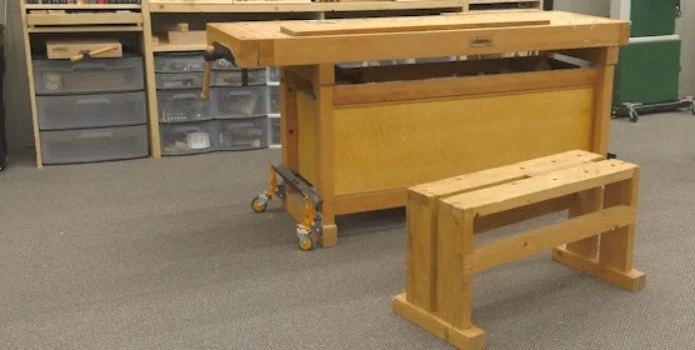
The most common workbench question I get is: How tall should a workbench be? And it would be nice if I could give you a number. But I can't, because the perfect workbench height depends on a lot of different factors.
What I can do is explain those factors so you can calculate your perfect bench height for the type of work you plan to do.
To understand bench height, we need to go back to the old-time days—when workbenches were designed around hand tools rather than machines.
What tool dominated those old shops?
Hand planes.
Before electric jointers, planers, and sanders, every surface of every board was planed by hand—often several times. A workbench wasn’t just a table. It was a giant work-holding jig designed specifically to hold boards at a comfortable height for planing.
A bench that’s too tall forces you to hold a plane high and work mostly with your arms. A lower bench lets you engage more of your body so you tire less quickly.
Knuckle Height, Wrist Height, and Everything in Between
Early woodworkers often preferred a bench height equal to the middle knuckle of their dangling arm—perfect for wood-bodied planes.
When cast-iron planes became common (with their different profiles), benches grew a bit taller—about wrist height.
But even historically, bench heights varied widely. Woodworkers were different sizes, preferred different tools, and did different kinds of work.
Different Tasks, Different Ideal Heights
No single height works for everything. Each task has a “sweet spot.”
Hand Planing
Best height: Knuckle to wrist height
Lower benches allow full-body power instead of just arm power.
Joinery Cutting
Best height: Around elbow height
Easier to see your work and make precise cuts.
Assembly
Best height: Fingertip height
More comfortable on your back while moving pieces around.
Panel Sawing
Best height: Just below knee height
This is why traditional saw benches are so low.
How to Find Your Perfect Height
Since no one bench height will be perfect for everything, experimentation is essential.
Step 1 — Create an Adjustable Mock Bench
Use:
A pair of sawhorses
A piece of plywood
Some blocking to raise or lower the height
This gives you a safe, temporary work surface.
Step 2 — Put a Board on the Mock Bench
You don’t work on the benchtop—you work on the board on top of the benchtop. So test with a board in place.
Step 3 — Test Your Common Tools
Hand planes
Routers
Jig saws
Chisels
Don’t turn on power tools unless the mock bench is solid—but get a feel for how your posture changes with height.
Add or remove blocking until it feels right.
You’ll Likely Need Compromise
Because different tasks favor different bench heights, you’ll rarely find a single height that does it all perfectly.
For example, if your eyesight isn’t what it used to be, or you hate bending over, you might favor a taller bench—even if it’s not ideal for heavy planing.
That’s okay. Comfort matters.
A Practical Solution: Multiple Surfaces
Most of us don’t have room for four benches. But you can still cover your bases:
✔ Standard Planing Bench
Pick a height comfortable for planing—often the most demanding task.
✔ Add-On Joinery Jig
A bench-top riser brings your work up for detail tasks.
✔ Build a Saw Bench
Great for handsaws, safe cuts, and many shop chores.
✔ Use the Assembly Table You Already Have
Many shops already have a higher surface perfect for glue-ups and layout.
Bench Plans & Resources
On our website, you’ll find:
Plans for a traditional Roubo-style workbench (construction-lumber friendly)
Wonder how this bench holds up over time? Read the review here.
Plans for a feature-packed split-top saw bench
Plans for a bench-top joinery jig
All of those are in the description below.
Final Thoughts
Finding the perfect bench height isn’t about hitting a number—it’s about matching the height to your tools, your body, and your work style.
Experiment, adapt, and build the bench that works for you.
Happy Woodworking!
This post may contain affiliate links. If you make a purchase, we may receive a small commission.
Need some cool tools for your shop? Browse my Amazon Storefront for inspiration.
