
WHY YOU NEED A VERNIER SCALE
A vernier caliper may look intimidating, but once you shift from fractions to decimals, it becomes one of the most precise measuring tools in the shop. With a little practice, you’ll be able to read measurements down to thousandths of an inch or hundredths of a millimeter with total confidence.
Making fun of the American system of measurement is practically an international sport. But if you think fractions are complicated—wait until you meet the vernier caliper.
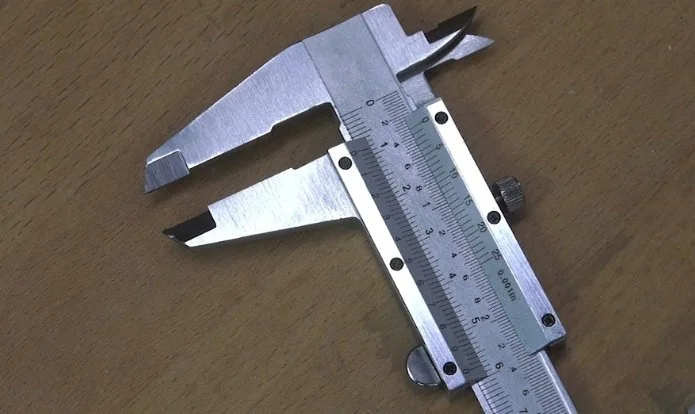
This simple analog tool looks intimidating at first, but once you understand how it works, it’ll let you measure with a precision you never thought possible—whether you’re using inches or millimeters.
And for my international readers: don’t worry, this isn’t just an imperial thing. I’ll show you how it works in both inches and centimeters.
What’s Going On With This Scale?
If you’re used to ruler scales divided into 16ths or 32nds of an inch, a vernier scale might look like something out of a sci-fi movie. But it’s actually quite logical once you think in decimals instead of fractions.
Each inch on the caliper’s main scale is divided into ten smaller increments—tenths of an inch. Each tenth is then divided again into four smaller increments.
So if the large red marks are inches, and the smaller green ones are tenths of an inch, what are those even smaller ones? They represent a quarter of a tenth—or 25 thousandths of an inch (0.025").
Thinking in Decimals
To keep things simple, think of your measurements in decimals. They’re much easier to add, subtract, and divide than fractions.
Here’s how it breaks down:
1/10 inch = 0.1 inch
0.1 inch = 0.10 or 10 hundredths of an inch
0.10 = 0.100 or 100 thousandths of an inch
Why add all those zeros? Because dividing 0.1 by 4 is awkward, but dividing 0.100 by 4 is easy—giving you 0.025 or 25 thousandths of an inch.
Reading the Vernier Scale (Imperial)
Now let’s apply that to the caliper. The main scale shows tenths of an inch (.1, .2, .3, and so on). Each of those tenths is divided into four marks: .025, .050, .075, and so forth.
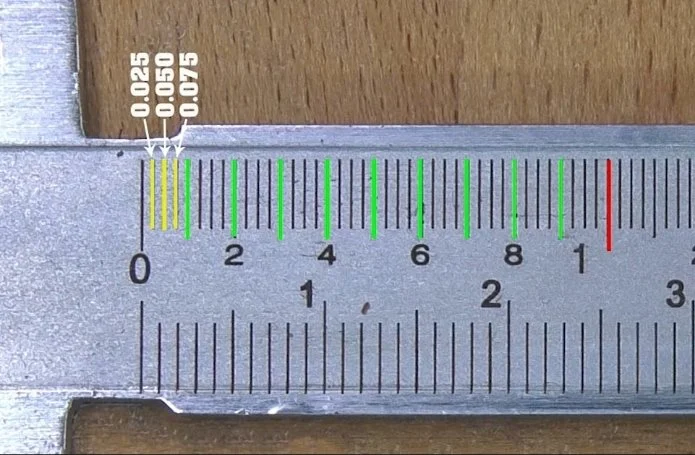
But what if you want even more precision? That’s where the vernier scale comes in.
Think of it like this: those 25 marks on the vernier scale are “squeezed” into the space of one of the smallest marks on the main scale. Each mark on the vernier scale equals one thousandth of an inch (0.001").
To use it:
Read the value that the zero mark on the vernier has just passed on the main scale.
Find the mark on the vernier scale that lines up exactly with a mark on the main scale.
Add that number of thousandths to your main scale reading.
Example 1:
The zero mark is between .125 and .150.
The 10th line on the vernier lines up.
Add .010 to .125 for a total of .135" (135 thousandths).
Example 2:
The zero mark is just past 1.025.
The 21st line aligns perfectly.
Add .021 to 1.025 for a total of 1.046" (1 and 46 thousandths).
Reading the Vernier Scale (Metric)
Now let’s switch gears to the metric side.
On the other side, the main scale is in centimeters, divided into ten millimeters. Simple enough. But if you want finer precision—fractions of a millimeter—the vernier scale helps again.
Each mark on the vernier represents one-tenth of a millimeter (0.1 mm). These are further divided into five smaller increments, so each tiny mark represents 0.02 mm (two hundredths of a millimeter).
Example:
The zero cursor is just past the “2” mark (21 mm).
The vernier’s “5” mark lines up perfectly.
Add .52 mm to the 21 mm reading.
Final measurement: 21.52 mm, or 2.152 cm.
Wrapping It Up
If you’ve never used a vernier scale before, it might seem like a lot of gobbledygook. But once you practice, it becomes second nature—and there’s truly no finer way to take a precise measurement with an analog tool.
Whether you’re working in inches or millimeters, mastering the vernier caliper opens up a whole new level of accuracy in your woodworking, metalworking, or any other kind of precision craft.
This post may contain affiliate links. If you make a purchase, we may receive a small commission.
Need some cool tools for your shop? Browse my Amazon Storefront for inspiration.
