
DO YOU NEED A SAWBENCH?
A good workbench is essential—but a sawbench (or two) can take your woodworking to the next level. This article makes the case for these old-school, highly versatile shop helpers and shows why they deserve a spot in your workspace.
Every woodworker knows they need a workbench. We’ve made plenty of workbench-related tutorials—you can find those on Youtube. But do you also need a saw bench, or two? I think so—and that’s what this article is about.
Saw benches are old-timey devices that many modern woodworkers seem to have forgotten. I think that’s a shame, because they are extremely versatile.
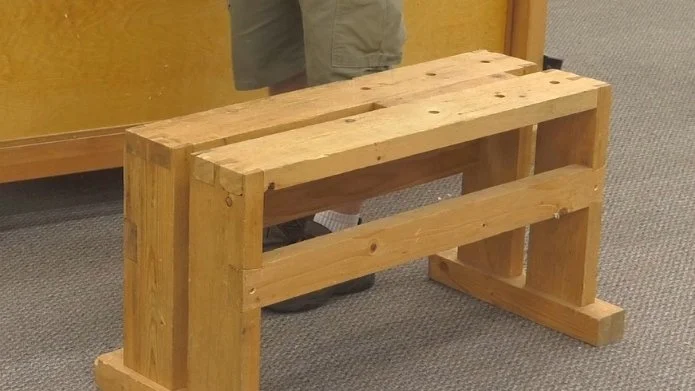
This is my version. I made it several years ago and have a set of detailed instructions for building one for yourself. Mine features a split top and dog holes—features that aren’t usually found on saw benches but should be, as you’ll see shortly. But we’re getting ahead of ourselves. Let’s talk about what makes a saw bench so handy.
What Is a Saw Bench?
Basically, it’s a short workbench. But the height isn’t arbitrary—it’s customized to your body.
Way back in the old-timey days, someone figured out that if you build a bench that comes up to about an inch below your kneecap, your body can be used as a clamp to hold your work.
Let’s say you’re crosscutting a board to length. Most boards are about an inch thick, so when you lay it on top of the saw bench it comes up to a comfortable height for placing your knee on top to hold your work.
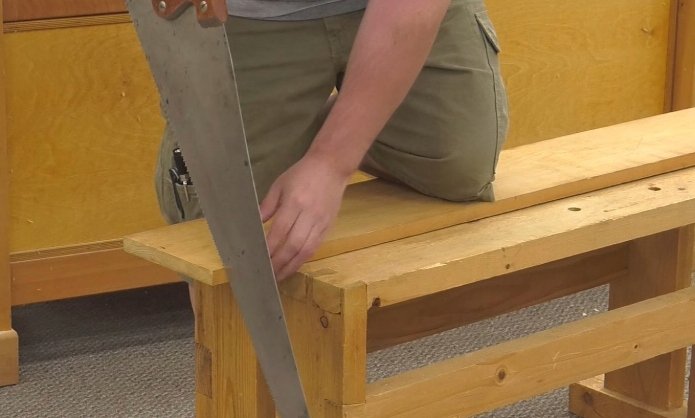
But downward pressure isn’t the only thing holding your work. You place your other knee against the edge of the board to control lateral motion. It’s a very comfortable, secure way to crosscut.
Why Power Tool Woodworkers Should Care
Even power tool woodworkers occasionally need to rough-cut long boards to length before machining them. A saw bench and a sharp crosscut saw are often quicker than getting out and plugging in the circular saw—and they’re definitely quieter.
If you’re really into hand sawing, a saw bench makes an ideal ripping tool as well. Traditionally, they featured a V-shaped notch at the end for that purpose. That notch could also be used creatively for other work-holding purposes, such as wedging a frame and panel upright when planing the edge.
Personally, I prefer a split-top design because it gives me more depth for ripping without cutting into my bench. This is especially useful when working with smaller pieces that need more support. Longer boards can also be ripped a foot or so at a time, advancing the board forward as you work.
Why You Might Need Two
Saw benches are usually made in pairs so the second one can support the far end of your workpiece. Having two also makes it possible to arrange them like sawhorses for project assembly and other tasks.
But the best part? You can use them to work sitting down when your feet or back get tired. (Don’t worry about cutting too far—like a fancy electronic table saw, an old-timey saw will quickly stop cutting when it hits flesh.)
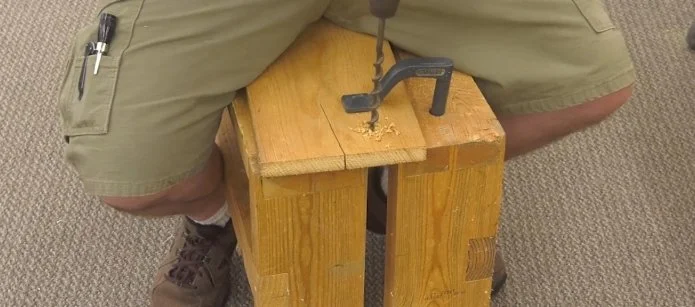
Speaking of working sitting down, the other end of my saw bench doubles as a sit-down work surface, complete with dog holes to secure your workpiece for mortising or other boring tasks. Get it?
Why I Still Use Saw Benches in a Power Tool Shop
This is primarily a power tool workshop, but I still love my saw benches. They’re cheap to build and extremely versatile:
Sawing
Chopping
Drilling
Sitting or standing on top
Assembling casework
Finishing large projects
Creating a low table by throwing a half sheet of plywood on a pair
The uses are endless.
Plus, they’re super affordable to build from basic construction lumber.
A Great Project for Learning New Skills
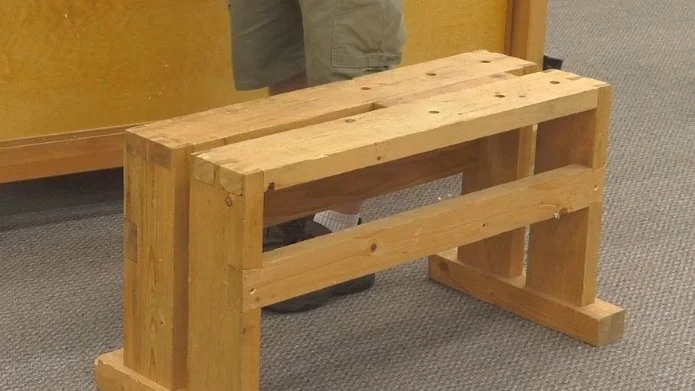
My design looks a little complicated with some dovetail joinery—but I designed it that way to encourage you to try new hand tool techniques. In fact, this is the perfect project to learn new skills, because it’s a saw bench—nobody cares if you have some gaps in your joints!
If you decide to build mine, the instructions will walk you through everything, including how to repair any mistakes you make. Check them out at the link below.
Even if you’re a power tool woodworker, you’ll find plenty of uses for a saw bench.
See you next time.
This post may contain affiliate links. If you make a purchase, we may receive a small commission.
Need some cool tools for your shop? Browse my Amazon Storefront for inspiration.
