
IS IT BETTER TO SAND, SCRAPE, OR PLANE WOOD?
Sanding, scraping, and planing each have strengths and trade-offs when preparing wood: sanding is the most forgiving and convenient, scraping is slightly faster but physically demanding, and planing is fast and effortless—if the wood cooperates. Choosing the right method depends on your skill level, project needs, and how much you prioritize speed, effort, and control.
Most woodworkers these days smooth and prepare their projects for finish with sandpaper. There are several tutorials about sanding on my Youtube channel. But every time I talk about sanding, I hear from folks who claim scraping or planing is a better option.
New woodworkers see this debate and naturally wonder: What’s the real difference between sanding, scraping, and planing?
Several videos have been made comparing samples of wood smoothed with each method. Some seem to show sanding produces a better surface; others show planing is superior.
The debate partly comes down to personal perception—different people see things differently. But other factors matter too: the quality and grit of the sandpaper, the sharpness of a tool’s edge, and especially the type of material being smoothed all influence how the final result is perceived.
In this article, I want to examine the topic from a different angle: the process. Which method—scraping, planing, or sanding— makes your time in the shop better?
To me, it comes down to three factors: time, effort, and convenience.
Time
Most people will tell you that planing is faster than sanding—and in my experience, that’s true if your plane is already sharp and ready to go. I can grab a smoother from my till and surface a board in just a few strokes.
With a sander, I’d have to work through several grits to get similar results. In fact, I probably wouldn’t reach the same level of smoothness, since I usually stop sanding at 220 grit—and a planed surface is smoother than that.
Now, sharpening does add time. Freehand sharpening might take two or three minutes, but if you’re new to it, you might spend 5–10 minutes or more getting your gear out, setting up a jig, working through the grits, and reassembling the plane.
Does this extra time make planing more time-consuming overall? I doubt it. A sharp plane iron stays sharp for a while—you won’t need to re-hone the edge for every board. Still, there are other factors that might slow you down, which we’ll get to in a moment.
What About Scraping?
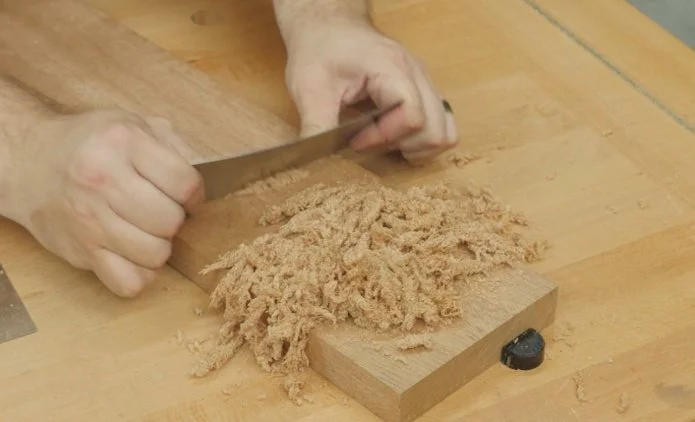
Like planing, scraping can technically be faster than sanding. You remove more material per stroke and only have to use one “grit,” so to speak. But depending on the material, a scraper’s edge may need frequent sharpening—sometimes more often than a hand plane.
Sometimes all that’s required is reforming the hook with a burnisher. But anyone who’s done a lot of scraping knows how often you must go through the full sharpening process—especially if you want a smooth surface. A scraper’s edge must be free of nicks, or you’ll leave ridges on the board.
Still, in my opinion, scraping is slightly faster than sanding, though not by much.
Effort
A random-orbit sander is lightweight and doesn’t require much muscle. Most of the work is done for you. That said, I always hand-sand the final grit to ensure a perfect surface, and that part requires a bit more elbow grease. It’s not exactly hard, but the repetitive back-and-forth motion can wear you out.
A scraper also takes multiple strokes to smooth a surface, but the real challenge is holding it properly. You typically bend it slightly to use a curved edge, and depending on the thickness of the steel and the strength of your hands, this can become uncomfortable fast. If you’ve never scraped for long periods, trust me—you’ll feel it. When you factor in the frequent edge maintenance, scraping is the most physically demanding of the three methods.
Of the three options, I think planing requires the least effort.
Now, I’m only talking about smoothing a surface—not flattening or thicknessing rough stock (which can be a workout). But with a well-tuned smoothing plane, it’s more pleasure than chore. Though the plane itself is heavy, you can use your body and the tool’s weight to create momentum. A razor-sharp iron will glide through wood effortlessly. Even accounting for the occasional sharpening, the relatively few strokes required to smooth a surface make planing the easiest physically.
Convenience
Up to this point, we’ve been talking mostly about the tools. But convenience often depends on the material you’re working with—and here’s where things change.
A hand plane creates beautiful shavings—if the wood cooperates. But wood rarely does. You might be going with the grain on one part of a board, and against the grain on another. Or the grain might curl right in the center, and before you know it, your plane tears out fibers and leaves you with a mess to fix.
When planing, you always need to watch grain direction. If you don’t, you risk ruining your work. That’s one reason many modern woodworkers avoid hand planes—they’re not always forgiving.
Scraping Is More Forgiving
Scraping is more flexible in this regard. While it’s still best to go with the grain, you’re unlikely to tear out fibers if the grain shifts. In fact, scrapers are often used specifically to deal with difficult grain or repair tear-out caused by planing.
This is thanks to the edge angle and the tool’s lighter touch. Scrapers also allow for localized work—stopping anywhere on the board without leaving visible marks.
But Nothing Beats a Sander for Convenience
Sanders don’t tear out. Technically, you can work in any direction. (I say “technically” because, while random orbit sanders are forgiving, hand sanding should always follow the grain to hide scratches.)
Still, with sanding, grain direction isn’t a major concern. Add to that the fact that sandpaper doesn’t require sharpening, and you can see why so many woodworkers prefer sanding.
The only real downside to sanding, in my opinion, is the dust and noise—but that’s what shop vacs, earplugs, and dust masks are for.
Final Thoughts: Which Method Wins?
Let’s review:
Sanding is the slowest method, but the most forgiving and convenient.
Scraping is slightly faster and more forgiving than planing but takes more physical effort and frequent sharpening.
Planing is the fastest and most effortless method—but only if the material cooperates.
If we stopped there, planing would come out on top. But materials don’t always behave. So when convenience is your top concern, sanding wins—especially for beginners or those who don’t want to worry about grain direction and tool sharpening.
That said, these factors often come down to personal preference.
Happy woodworking!
This post may contain affiliate links. If you make a purchase, we may receive a small commission.
Need some cool tools for your shop? Browse my Amazon Storefront for inspiration.
