
HOW TO GET A FLAT TABLE TOP FROM CONSTRUCTION LUMBER
Learn how to choose construction lumber that stays flat by identifying straight-grain, rift-sawn, and quarter-sawn sections hidden inside wide boards. This guide shows how smart wood selection—plus a simple cutting strategy—can turn inexpensive home-center pine into a long-lasting, stable tabletop.
Some time back, a friend wanted to build a table using simple pine construction lumber from a home center—and this is what he ended up with.
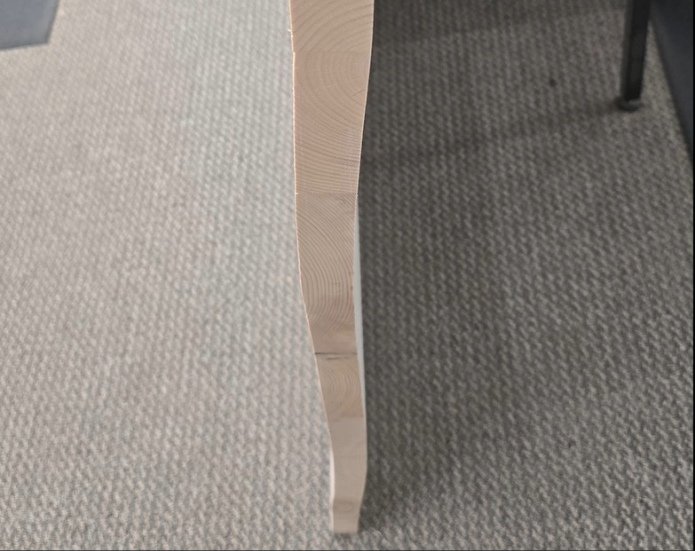
In this article, I’ll walk you through how I solved his problem and helped him go from that to this...

By the end, you’ll know exactly how to pick the right boards so you can make a tabletop (or any furniture surface) that stays flat and looks great for many years.
The Problem: Cheap Lumber, Big Expectations
Like many of us, my friend wanted to build a quality piece of furniture without spending a huge amount of money. It was also a great chance to get his kids involved—always a fun bonus—so I offered my shop, though I tried to stay mostly hands-off.
He selected his own wood: mostly 4x4s for the base and 2x8s for the top. We stickered the boards to dry for a few weeks and then began the build. I was skeptical that we’d get a really good tabletop out of the lumber he chose, but it was his project, so he milled the boards and glued them up.
Sure enough, a few days later… it warped. Badly.
I wish I had planned ahead and taken more photos, but seeing the top twist into a potato chip was the moment I realized: this could be a great teaching opportunity.
Back to the Home Center — With a Plan
So it was back to Home Depot. This time I told him to choose the widest boards he could find with the straightest grain possible. Of course, that’s easier said than done with construction lumber. So I told him to buy about 30% more wood than he thought he needed. I promised the waste would pay off—and it absolutely did.
Before moving on, you need to understand a little about how wood moves. If you read the article from earlier this week, you’re probably wondering:
“Where do I even find quarter sawn lumber?”
Good question. You won’t find it at Home Depot… unless you know where to look.
The Secret: Buy Wide Boards and Cut Out the Good Wood
As I said, I had him buy wider boards—2x10s and 2x12s. Then I took a marking pencil to the end grain.
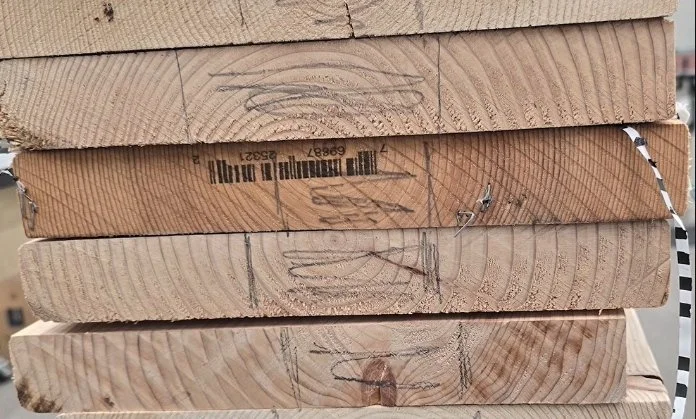
I marked off the parts of each board that grew closest to the center of the tree—those tight circular rings that indicate unstable, center-cut grain. What remained were the portions with relatively straight, consistent rings—functionally rift sawn or even quarter sawn sections.

This process wastes some wood—maybe as much as a third—but the payoff is huge: a flat, stable tabletop.
The Results: Straight Grain Wins Every Time
Here’s what we ended up with:
A tabletop made from boards whose grain lines run consistently down the length. Sure, a few knots break up the perfect flow, but the overall look is clean and controlled. Not only is this wood more stable—it’s more beautiful. Give me straight grain over cathedral grain any day.
We used biscuits to help keep the panel aligned during glue-up, but that’s optional—otherwise it’s just glue and clamps.
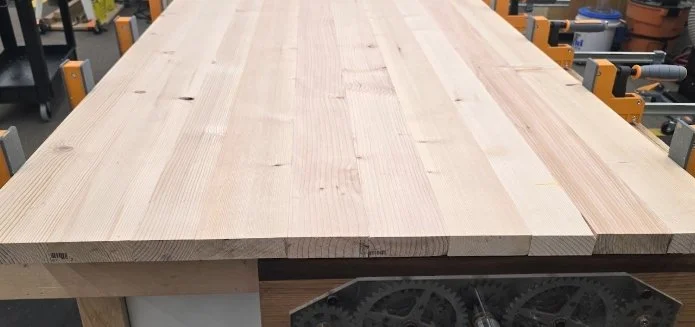
The new top remained in my shop for a couple of months. It stayed perfectly flat, because this time we took the time to select the right parts of the lumber—even though it still came from the construction racks at a home center.
Another Solution: Breadboard Ends
Of course, there’s another way to help keep a tabletop flat: breadboard ends.
If you’d like to see how we made those, check out the next blog article on Tuesday.
This post may contain affiliate links. If you make a purchase, we may receive a small commission.
Need some cool tools for your shop? Browse my Amazon Storefront for inspiration.
