
THE CHALLENGES OF MIXING WOOD FINISHES
Mixing wood finishes doesn’t have to be a gamble—this guide breaks down which oils, polys, shellacs, and waxes play well together (and which don’t). With clear rules and pro tips, you’ll avoid sticky disasters and get the finish you actually want.
Most woodworking projects are typically coated with a single finish. Maybe a few coats of a natural oil such as boiled linseed oil. Or a few coats of shellac, lacquer, or polyurethane. Basically, the first coat is the same type of finish as the final coat.
But not always. There are times when you may want to switch finishes from one coat to the next. For example:
Some claim a base coat of tung oil really enhances the grain, but they also want a topcoat of varnish for protection.
Others might apply an oil-based stain, but wonder if they can then use a water-based polyurethane.
Or maybe you’re refinishing an older piece of furniture and don’t know if you must sand all the old finish off before applying something new.
Knowing what finishes are compatible with each other can mean the difference between success and disaster. This guide will help you understand the how and why of switching finishes between coats.
We’ll focus on five most common finish types used in small shops:
Natural penetrating oils
Oil-based film finishes
Water-based polyurethane
Alcohol-based shellac
Paste wax
Natural Penetrating Oils
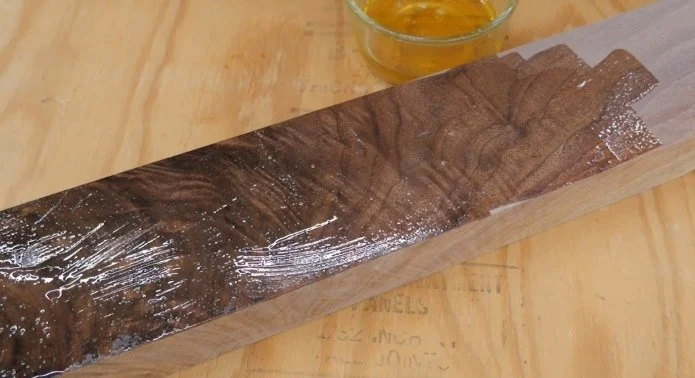
The most common penetrating oils are boiled linseed oil (BLO) and tung oil. These soak into the wood fibers rather than building a hard protective shell.
As I explained in a previous tung oil tutorial, these oils take weeks or even months to fully cure. Don’t mistake drying for curing. Drying happens when solvents evaporate. Curing is a chemical reaction where oxygen hardens the finish. Only after curing can some finishes be applied on top.
Compatible: Oil-based polyurethane can go over uncured penetrating oils, since oil is compatible with oil.
Not compatible: Water-based poly cannot go over uncured oil finishes. Oil and water don’t mix.
Some argue plant-based oils never fully cure to a hard shell, so they don’t play well with water-based finishes. Linseed oil, for example, always remains somewhat soft.
Solution: Use dewaxed shellac as a barrier coat. Shellac sticks to almost anything, and almost anything sticks to it. If you want the grain-enhancing qualities of tung oil but also the protection of water-based poly, put a coat of dewaxed shellac between them.
This same barrier coat works if you want to put water-based poly over an oil-based stain.
Oil-Based Film Finishes
These include oil-based polyurethane, varnishes, and some lacquers. Unlike penetrating oils, they form a hard protective shell.
Oil is compatible with oil, so these finishes can go directly over BLO or tung oil.
They can also go over water-based finishes—if fully cured.
A fully cured film finish contains no significant oils, meaning it won’t repel water-based topcoats. The reverse is true as well—oil-based poly can go over a cured water-based finish.
Important: Don’t confuse drying with curing. Drying takes hours. Curing takes days or weeks. If you can still smell solvents, it’s not cured yet.
Bonding: Some film finishes (like polyurethane) don’t chemically bond to new coats once cured. You must scuff-sand with fine grit or steel wool to create a mechanical bond. Exceptions include shellac and some lacquers, which can re-dissolve into themselves.
Shellac
Shellac deserves its own mention. Dewaxed shellac can act as a universal sealer between almost any finishes. It bonds well to oils, water-based finishes, and varnishes.
Fresh coats of shellac also bond to older coats because the alcohol re-dissolves the finish.
Wax
Paste wax is a blend of wax and oil-based solvents. The solvents evaporate, leaving wax behind.
Wax will stick to almost anything.
Almost nothing sticks to wax.
That makes wax a fine topcoat, but if you want to recoat with anything else later, you must remove all the wax with mineral spirits or another solvent.
Key Takeaways
Penetrating oils (BLO, tung) can be recoated with themselves, but water-based finishes need a barrier coat of dewaxed shellac.
Oil-based film finishes can be mixed with water-based finishes if the first finish is fully cured and the surface is scuffed for bonding.
Shellac is the universal problem-solver—great as a barrier and bonds to almost anything.
Wax can go on top of anything, but nothing can go on top of wax.
Save this guide—you’ll probably forget some of these rules when you need them later.
Happy woodworking!
This post may contain affiliate links. If you make a purchase, we may receive a small commission.
Need some cool tools for your shop? Browse my Amazon Storefront for inspiration.
