
THE COOL GUYS ALL HAVE 9 FINGERS
Back when I was growing up, being cool was all about torn jeans, flannel shirts and Pearl Jam records. It wasn’t just the look; it was the attitude. As time passed, I went into woodworking where I learned that being cool was still about attitude. Now I was expected to rage against painted wood, Chinese tools and most importantly, “the safety police.”
I can’t say I have ever seen these officers in uniform, but everyone talked about them. They had names like “Nancy” or “Karen”, and their presence was always felt behind the nearest wood pile or tucked inside a cabinet, ready to rat us out for doing awesome things like freehand cutting on the table saw.
I should explain that I grew up in a family with a long legacy of super-coolness. They were iron workers who walked the beams high above turn of the century Detroit. Safety police? Not hardly. Their only safety gear was a pair of heavy gloves and some Union overalls with a pack of smokes in the bib pocket and a bottle of ripple in the back. Great-grandpa Russ gritted his teeth while his shop buddies nipped off his crushed thumb behind the first knuckle so the stump wouldn’t get rheumatism. My father once sewed a good portion of grandpa’s nose back on with a needle and thread after an angle grinder accident. They were tough and they didn’t have time for nonsense. I grew up in workshops with all sorts of tools, but not a single pair of safety glasses or any sort of hearing protection. As a kid, every tiny scar I accumulated was a badge of honor, especially the giraffe-shaped gash on my forefinger that remains barely visible today.
Being raised that way had a profound impact on my early attitude toward safety. As a result, I’ve done a lot of dumb stuff and had several close calls with woodworking tools. What changed things for me was a run-in with a wood chisel.
The tool was in my right hand and my left was carelessly placed in its path as I held the work. When the chisel slipped, the tip caught me in the web of flesh between my thumb and forefinger. In an instant, it passed through the hand, and I reflexively pulled it back out. I was lucky that it was a very narrow chisel. Otherwise, I may have severed a tendon or lost a thumb. But there I was, bleeding into a rag and thinking “don’t be a sissy!” So, I grabbed a sewing needle, a bit of thread, some alcohol to soak it in, and I set off to honor the family legacy.
Sewing needles are simply not designed for suturing human flesh. It wasn’t very sharp, and it took a lot of pressure to drive it in. I could have used a couple more stitches than I managed that day, but the task wasn’t anything like I remembered from grandpa’s stories. As I examined my needlework, imagining the scar I’d have and the story I could add to our family lore, all I thought was “STUPID! STUPID! STUPID!” I was pretty sure my whole arm was going to turn green and fall off from infection. Was this what it meant to be cool? I wasn’t sure anymore.
That wasn’t my last shop accident. I’ve needed more stitches over the years (the medical professionals do a much better job) and I’ve kicked myself for doing something dumb a time or two. I am human, after all. But I stopped thinking it was cool to be cavalier with my fingers and other body parts because becoming shredded meat is about as far from cool as you can get. I’ve changed my attitude and most importantly, I’ve changed how I work.
These days I have little patience for people who openly mock basic safety practices. Nobody thinks you’re “edgy” because you don’t care about your digits, and a seeping eye patch doesn’t have the romantic charm that pirate movies suggest. We are not fourteen anymore and the woodshop isn’t homeroom. It’s time to grow up and realize that adults need full-length arms for all sorts of important tasks.
Don’t get me wrong. I’m not going to come into your shop and force you to put the blade guard back on your saw. That’s your decision. But how about we stop publicly shaming people for wanting to do things safely? It’s not just harmless mocking. We are training (and shaming) each new generation to think blade guards are for suckers and dust masks are how Big Brother keeps us under his bootheel. It’s a cycle that must be broken. Instead of teaching others how to be the coolest 9-fingered guys in their shop, how about we show them how much better their work can be with a full complement of fingers, eyes, ears, and lungs?
Take it from a guy who once laughed at Safety Sally while he stitched up his own wounds. At some point we all have to look in the mirror and realize what we thought made us look cool, made us look dumb.
-James Hamilton
NEW STUMPY NUBS HATS
HOW TO STOP TABLE SAW SCORCH MARKS
Here are some tips to reduce or eliminate scorch marks when using the table saw:
1. Understand the cause. Scorch marks are caused by heat buildup from friction that actually burns the wood fibers. It’s not just a cosmetic issue. The blade is getting overheated, as well. This can dull it prematurely.
2. Clean your blade. As you cut wood, resin and pitch build up on the blade’s teeth. Some woods—especially pine—can dirty a blade relatively quickly. Make a habit of inspecting your blade. When the teeth start to look grimy, it’s time to clean them. You can find a tutorial I made that shows how to properly clean a saw blade here.
3. Sharpen your blade. Unfortunately, blade sharpness is hard to judge by touch alone. Unless you have a brand-new blade for comparison, it’s difficult to say whether a blade feels slightly dull or very dull. Because of that, it’s best to rule out other causes of scorching first. If none of those solutions help, then sending your blade out for sharpening is a good next step.
4. Feed rate matters. If you feed too slowly, the blade’s teeth pass over the same wood fibers more times than necessary, generating excess heat. Consistency is just as important as speed. You need to keep the board moving smoothly through the cut. Any pause or significant slowdown is a prime opportunity for burn marks to appear.
5. Tooth count matters. More teeth on the sawblade mean smaller gullets between them. Smaller gullets have a harder time clearing sawdust, which leads to heat buildup. Combination blades with 40–50 teeth work well for most 3/4-inch material, especially softwoods like pine. But thicker boards produce more sawdust. A 24-tooth rip blade cuts more aggressively, clears sawdust faster, and often eliminates scorching when ripping thick stock.
6. Check your alignment. Another common cause of scorch marks is a misaligned table saw. Both the fence and the blade must be parallel to the miter slot. A quick check can be done with a combination square: let the body of the square ride in the miter slot while the rule touches the blade or fence. If things aren’t parallel, adjustments are needed.
7. Sometimes, it’s the wood. Some species scorch very easily. Maple is notorious for burning, as are walnut and cherry. Very hard woods like purpleheart and other exotics are also prone to scorching. In some cases, it simply isn’t possible to eliminate burn marks completely and the goal should be to minimize them. If the marks are light and shallow, they can usually be sanded away without much trouble.
If you’d like to learn more, I made a whole tutorial about it. Enjoy!
MORE ARTICLES FROM MY SHOP VLOG:
STUMPY’S DEEP THOUGHTS:
I know it’s important to breastfeed your infant, but what about the wings and thighs? Do you just leave the whole bucket in the crib?
I’m afraid arming police with pepper spray will only lead to more seasoned criminals.
I just watched the TV show “How It’s Made” and honestly, I’m never eating another urinal cake again.
There’s no good path to take when you come to a spork in the road.
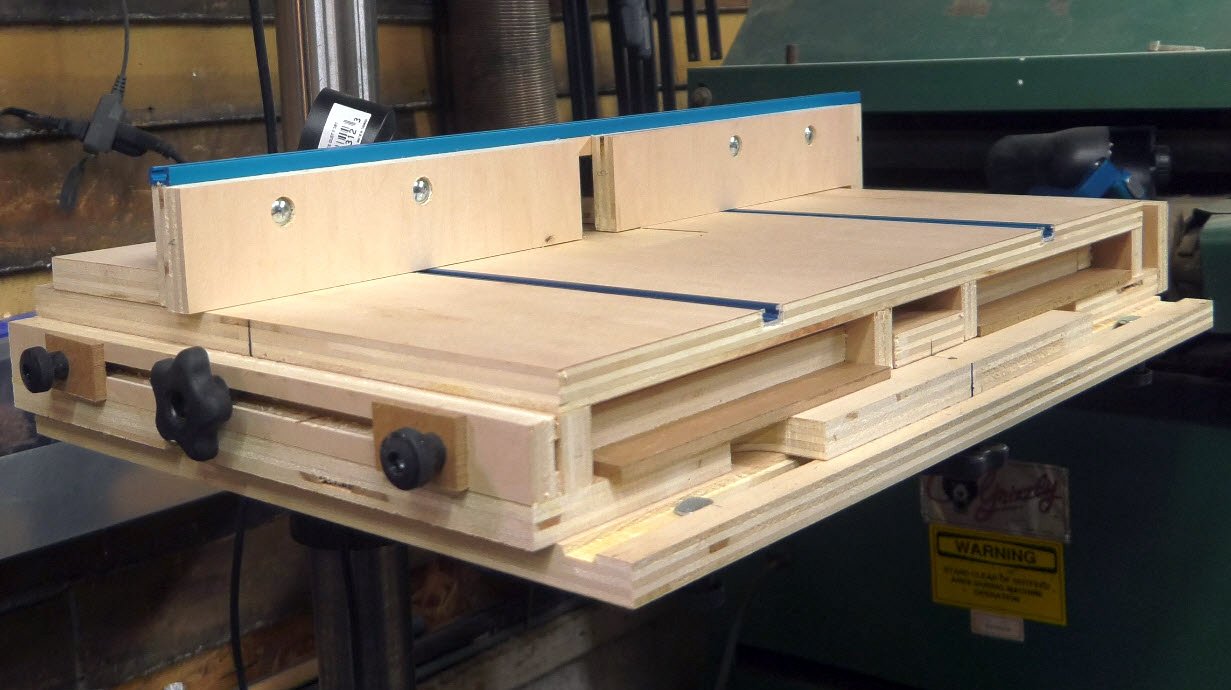

Easily cut dovetail pins with a small trim size router. The mating tails can then be done with a hand saw, band saw, or jig saw. This jig gives you full freedom for width and spacing for a custom hand cut look that cannont be achieved with typical router jigs. May also be used to create both through and half blind dovetails. Simple to build and easy use. These are digital plans. You will not receive a paper copy.