
CHOOSING THE RIGHT GLOVES FOR YOUR WOODWORKING PROJECT
Not all finishing gloves protect against the same chemicals, and the wrong choice can expose you to solvents—or even ruin your finish. Learn the strengths and weaknesses of vinyl, latex, and nitrile gloves, plus the surprising contamination problem that catches many woodworkers off guard.
I always wear gloves when applying a wood finish for a very simple reason: I don’t want the mess on my hands.
But there’s a more important reason than convenience.
Many of the chemicals used in wood finishes and solvents can irritate your skin, and some are genuinely hazardous with repeated exposure. The problem is that a lot of woodworkers treat gloves like a one-size-fits-all solution. They grab whatever cheap box is on the shelf and assume they’re protected.
That’s not always the case.
Different gloves resist different chemicals, and using the wrong type can give you a false sense of security. So let’s break down the three most common glove materials used in woodworking—vinyl, latex, and nitrile—and talk about where each one works well, where it doesn’t, and one finishing mistake that caught me completely off guard.
Vinyl Gloves: Cheap and Good Enough… Sometimes
Vinyl gloves are usually the least expensive option, and for certain finishing tasks, they work just fine.
They’re a reasonable choice for:
Water-based finishes
Wipe-on oils like boiled linseed oil (BLO) or tung oil
They’ll also protect your skin from chemicals commonly found in water-based products, including ethylene glycol.
But vinyl gloves have limitations.
They don’t hold up particularly well to stronger solvents, and I would avoid using them with:
Wiping varnishes
Danish oils
Solvent-heavy finishes and thinners
Another issue is durability. Vinyl tears fairly easily, especially around sharp edges and corners. And once a glove tears during a staining or dyeing process, you usually don’t notice it until your fingers are covered in color.
Latex Gloves: Better with Alcohol-Based Finishes
Latex gloves are only slightly more expensive than vinyl and generally offer better chemical resistance and flexibility.
They perform reasonably well with:
Shellac
Alcohol-based finishes
Water-based products
But again, durability becomes the issue.
Cheap latex gloves tear easily, especially during finishing work where you’re constantly handling edges, parts, and abrasive surfaces. They’re adequate for light-duty work, but I don’t consider them ideal for serious finishing sessions.
And there’s another issue with latex that many woodworkers never think about—which I’ll come back to in a minute.
Nitrile Gloves: The Best Overall Choice
For most woodworking finishes, nitrile gloves are the clear winner.
Nitrile is a synthetic rubber that:
Resists punctures and tears better than latex or vinyl
Handles most common woodworking solvents
Holds up well against oils, stains, film finishes, mineral spirits, and alcohol
That makes them the most versatile option for the average shop.
In my own finishing work, nitrile gloves are what I use almost exclusively.
But that doesn’t mean they’re indestructible.
What Nitrile Gloves Won’t Protect Against
Some solvents are aggressive enough to attack nitrile directly.
Chemicals like:
Methyl Ethyl Ketone (MEK)
Xylene
Lacquer thinner containing xylene
…can eventually break nitrile down.
Now, most finishes won’t instantly dissolve nitrile gloves. Exposure time matters, and glove thickness matters. That’s why heavier latex or PVA gloves are often sold specifically for stripping and refinishing work.
Some people even wear multiple layers of disposable gloves for extra protection.
Personally, I don’t like guessing games when it comes to chemical exposure.
How do you know if you have enough layers?
How do you know when the chemicals are getting through?
By the time you feel tingling in your fingers or notice the gloves softening, you’re already being exposed.
Will occasional exposure ruin your health overnight? Probably not.
But if the proper glove for the chemical exists, why gamble?
If I’m working with particularly strong solvents, I buy gloves specifically rated for those chemicals. Otherwise, I stick with nitrile for nearly everything in the shop.
Why Reusing Gloves Is a Bad Idea
Because nitrile gloves cost more, some people reuse them over and over until they finally rip apart.
If you’re relying on them for chemical protection, this is a bad idea.
The longer a glove is exposed to solvents, the more it degrades—even if it still looks intact.
I’ll often keep the same pair between coats during a single finishing session. But once the project is done, the gloves go in the trash.
Compared to:
The cost of the wood
The finish itself
The time invested in the project
…a fresh pair of gloves is cheap insurance.
The Strange Finishing Problem Gloves Can Cause
Now here’s something that surprised me the first time I encountered it.
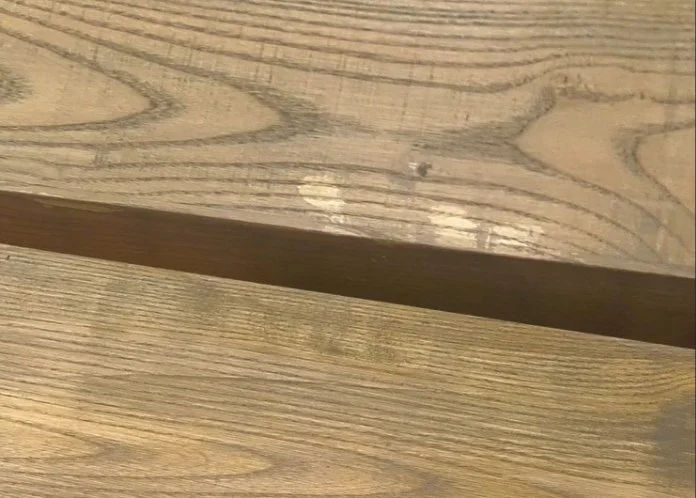
Have you ever seen strange blotchy spots appear after applying your topcoat?
Not glue spots.
Not sanding scratches.
Not uneven stain absorption.
I had this happen once on a project, and it drove me crazy.
I resanded and refinished the piece, convinced I had missed some glue squeeze-out. But the spots came back again—only in different places.
That’s when I realized the problem wasn’t the wood.
It was the nitrile gloves.
Gloves Can Contaminate Your Finish
Some disposable gloves—especially latex, but occasionally nitrile as well—have coatings or release agents on them to make them easier to put on.
Those coatings can transfer onto stained wood surfaces without being immediately visible.
The really frustrating part?
You often won’t see the contamination until:
The stain dries
The film finish is applied
Suddenly, weird blotches appear where the finish reacts differently.
The lesson here is important:
Don’t touch stained or finished surfaces with your gloves unless you know they’re clean and residue-free.
Just because you can’t see fingerprints doesn’t mean they aren’t there.
And they may not reveal themselves until it’s far too late.
Final Thoughts
When it comes to wood finishing, gloves aren’t just about keeping your hands clean. They’re part of your finishing system—and like every other part of that system, the details matter.
Use the wrong glove, and you may:
Expose yourself to solvents
Tear through the material mid-project
Contaminate your finish without realizing it
For most woodworking tasks, nitrile gloves are the best all-around choice. But no glove works for every chemical, and no glove lasts forever.
Choose the right protection for the material you’re using, replace gloves when they’ve been exposed too long, and be careful what touches your finish surfaces.
Because sometimes the problems that ruin a finish aren’t the ones you can immediately see.
This post may contain affiliate links. If you make a purchase, we may receive a small commission.
Need some cool tools for your shop? Browse my Amazon Storefront for inspiration.
