
RED VS WHITE OAK - IMPORTANT DIFFERENCES
Red oak and white oak may look similar, but their differences can make or break your project. This guide cuts through the confusion with simple, woodworker-focused advice on how to tell them apart and when to use each.
There are plenty of videos and articles out there about red vs. white oak—but most of them focus on flooring or contain details that aren’t very useful for woodworkers who just want to build a bookshelf, end table, or an outdoor project.
So I thought I’d make this short, woodworker-focused primer on the sometimes confusing differences between the two types of oak—and how to choose the right one for your next build.
The Basics: Two Families, Many Species
There are hundreds of species of oak, but they all fall into two main groups: red oak and white oak.
For example, English oak belongs to the white oak family, while California black oak belongs to the red oak family. So when you ask for “red oak” at the lumberyard, you’re not getting a single species—you’re getting lumber from an entire family of trees.
That’s an important distinction because it means inconsistencies are inevitable. Some white oak boards can look surprisingly red, and some red oak can appear quite pale. In other words, the names don’t necessarily refer to the actual color of the wood.
Why the Names?
The reasoning behind the names “red” and “white” oak is often debated. Red oaks tend to have reddish-brown leaf buds or leaves that turn red in autumn. White oak trees often have lighter-colored bark and leaves with pale undersides.
There are other botanical differences too—like the shape of the leaves and the look of the acorns—but this isn’t a tree identification guide. It’s about the lumber—and the most important difference for woodworkers comes down to pores.
The Key Difference: Open vs. Closed Pores
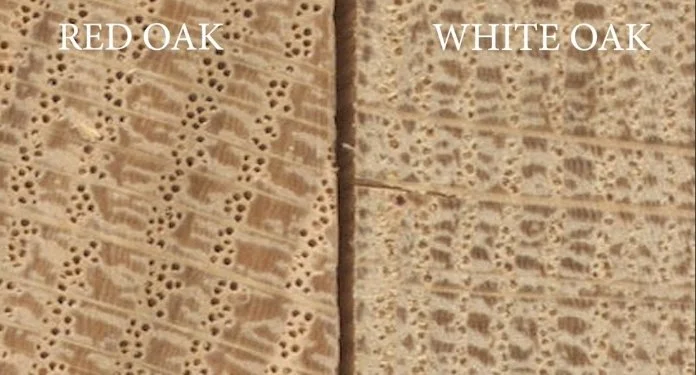
Red oak features open pores that look like bundles of tiny straws. You can actually stick one end of a red oak board in water and blow bubbles through it (as my friend Jim Heavey once demonstrated).
White oak, on the other hand, has pores filled with a natural resin. This makes it denser, heavier, and more moisture-resistant.
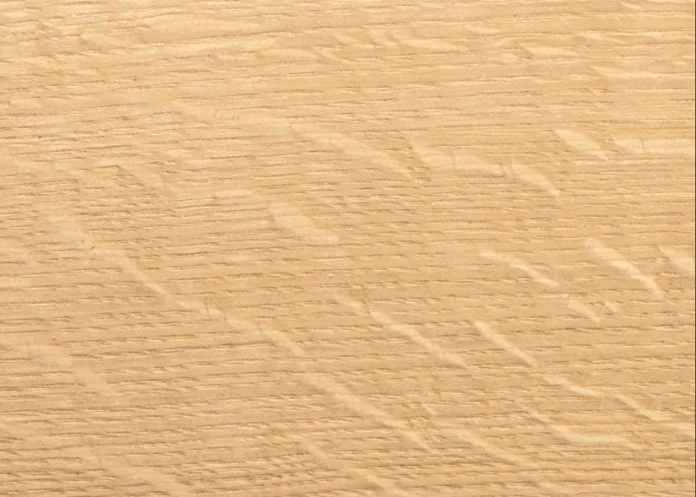
On the surface, white oak often shows more prominent medullary rays when it’s quarter-sawn—those distinctive patterns you see in Craftsman or Arts and Crafts-style furniture. Red oak can show rays too, but they’re usually less pronounced.
Because both types vary across species, the best way to tell them apart is to look at the pores, not the color.
Choosing the Right Oak for Your Project
If you’re building an outdoor project, white oak is the better choice. Its closed pores resist moisture and rot, making it naturally durable without chemical treatment.
For indoor furniture, both species perform well. Red oak is generally more affordable and easier to find, at least in most regions.
Both are hard woods, but white oak is denser and can dull your tools faster. I also find white oak splinters to be nastier.
Color, Consistency, and Mixing
You can’t simply look at a board and assume “that seems pretty red—it must be red oak.” Color varies widely within both families.
For that reason, it’s best to buy all the lumber for your project at one time and from one source. The next batch might look noticeably different.
Here in the Midwest, most of the red oak we see comes from species that are quite red. Since I don’t want everything I build to look like it belongs in a Cracker Barrel restaurant, I often seek out white oak instead. It’s not hard to find at hardwood dealers, and it usually costs only a little more.
That said, even white oak can vary from creamy to tan to slightly reddish, depending on the species.
Mixing Red and White Oak
In fact, I’ve taken advantage of their color similarities by mixing red and white oak in the same project.

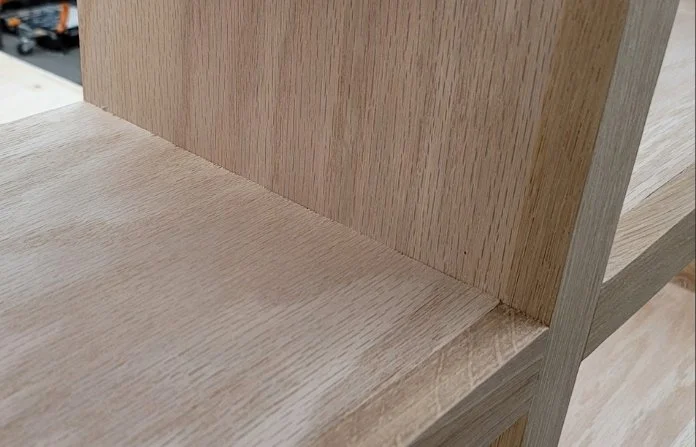
For example, in the bookcases seen above, the visible sides and shelf edges are solid white oak, while the panels are red oak plywood from the home center. White oak plywood is usually special order and costs up to three times as much. But by pairing the two types carefully, the difference is practically invisible—unless you know to look for it.
The Bottom Line
Both red and white oak are excellent choices for indoor furniture.
White oak is the better option for outdoor projects because of its closed pores and moisture resistance.
Color can vary within both families, so buy all your boards together for consistent appearance.
White oak is denser, a bit tougher on tools, and slightly more expensive—but often worth it.
No matter which you choose, you’ll be working with one of the most time-tested, reliable hardwoods around.
This post may contain affiliate links. If you make a purchase, we may receive a small commission.
Need some cool tools for your shop? Browse my Amazon Storefront for inspiration.
