
DO JAPANESE SAWS CUT FASTER THAN WESTERN SAWS?
Discover whether Western push saws or Japanese pull saws are faster in the workshop. This detailed comparison explores rip cuts, crosscuts, and joinery to help woodworkers choose the right saw for their style.
Awhile ago I released a video on why so many woodworkers have abandoned their Western-style push saws in favor of Japanese-style pull saws.
Videos like that often spark lively discussions in the comments section, and one of the most interesting debates was over which is faster: a saw that cuts on the push stroke or one that cuts on the pull stroke. Some were very insistent that the push stroke is faster because you can put your weight behind it, while others are just as insistent that pull saws are faster due to the way the human body is designed—or for any number of other reasons.
Of course, it’s always best to go out to the shop and see for yourself. So that’s what I did.
Putting It to the Test
I selected several different saws—some that cut on the push stroke, others that cut on the pull. I made several cuts: some with the grain, others across it. I even tried some fine joinery cuts. While the results seemed to lean one way at first, there was an unexpected twist that you really have to stick around for.

Let’s start with a Japanese Ryoba using the edge with rip-filed teeth. I didn’t count the few small strokes it took to start the saw, but once it bit in, I counted each pull stroke. It took 24 to reach my line.
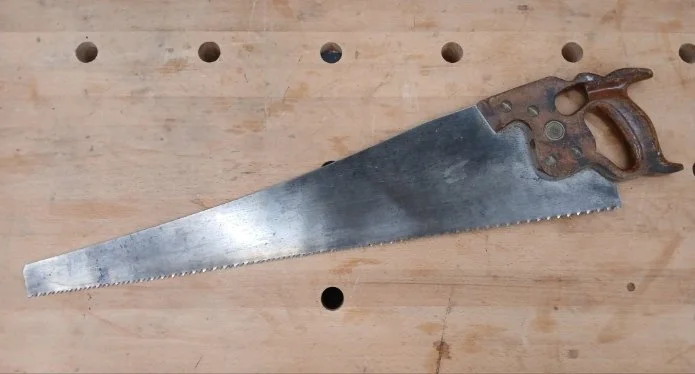
Then I picked up my Disston rip saw. Again, I let it get started before counting. It took just 18 strokes to hit the same line.
The Western push saw took 25% fewer strokes. Of course, it had an advantage: it has 5-1/2 teeth per inch, while the Ryoba has 7 teeth per inch. Fewer teeth allow each one to take a more aggressive bite, and therefore, cut faster.
Apples to Apples?
I wanted an apples-to-apples comparison. But if you go to a hardware store in search of a Western-style rip saw, you’re unlikely to find one. They're still available in specialty shops, but most consumer saws today are generically labeled "tooth saws." These feature triple-ground teeth that claim to cut in both directions—whether you're making a rip cut or a crosscut.
So I tried one of those. Once started, it took 19 strokes to reach my line—pretty much the same as the Disston rip saw.
That’s interesting because the DeWalt saw is supposed to cut on both the push and pull strokes. But in actual practice, it wasn’t twice as fast. More on that in a bit.
Moving to Crosscuts
Next, I moved on to crosscuts. I started with the crosscut edge of the Ryoba. I made sure to let the tool do the work—I wasn’t trying to win a race, because forcing the saw just leads to poor-quality cuts. The result was 27 pull strokes.
Then I tried another Disston saw, this time with crosscut teeth. It has 8 teeth per inch, which is more aggressive than the 9-1/2 teeth per inch on the Ryoba’s crosscut side. It finished the cut in 23 push strokes—only four fewer.
Then came the hybrid saw again. You’ll recall it wasn’t any faster than the single-cut Western rip saw earlier. But now on a cross cut, it completed the cut in just 15 push strokes—much faster than the 23 strokes from the dedicated Western crosscut saw.
Why? Because the teeth of the hybrid saw are not rip teeth. The only reason it kept up earlier was that it cuts somewhat in both directions. Essentially, it cuts with the grain only half as well, but gets in twice the strokes.
When cutting across the grain, as this type of beveled-edge tooth is designed to do, it can really take advantage of the double-cutting action. It’s actually not a bad saw for rough work.
Fine Joinery Cuts
Now for some finer cuts.
First, I compared two all-purpose joinery saws: a Western-style tenon saw and a Japanese-style Kataba. Because these are shorter cuts, I made three per saw and added up the strokes.
With the Kataba, it took 15 pull strokes to complete the three kerfs.
With the tenon saw, it took 12 push strokes. That’s pretty close—just one more stroke per kerf for the Kataba.
Now, let's compare a finer pair of saws: a Western-style dovetail saw and a Japanese Dozuki. Again, check out this vlog if you want more on the different types of Japanese saws.
The Dozuki completed the three cuts in 15 pull strokes. The dovetail saw? Also 15 push strokes. A tie.
In my opinion, when it comes to fine joinery saws, it’s really a draw between the speed of push cuts and pull cuts. Frankly, you can easily save or add a stroke to any of these cuts based on how much pressure you apply.
The Twist
And that’s where the twist in this test comes in.
I went back and made those crosscuts again—this time more aggressively. After all, most people use handsaws for rough crosscuts these days. Speed matters more than perfection. So this time, I used two hands and added more of my own strength. That reduced cut quality, but it really sped things up. Here’s what happened:
DeWalt hybrid saw: 19 push strokes
Disston crosscut saw: 15 push strokes (down from 23)
Ryoba pull saw: just 9 pull strokes
Why so few with the Ryoba? Because it’s easy to apply a lot of pressure using two hands on its straight handle.
And that’s the problem with debating whether it’s better to cut with a push or pull stroke: not everyone treats their tools the same way or does the same type of work.
Final Thoughts
In my case, when I focus on accuracy and quality—letting the tool do the work—I think the extra weight and aggressive teeth of many Western-style push saws make them a little faster for dimensional rips and crosscuts. For fine joinery, I found no meaningful speed difference between Western and Japanese saws.
But when I wanted to rough-dimension quickly, the straight handle of the Japanese pull saw made it easier to cut aggressively, especially in the position I was working at the bench. If I were leaning over the work—such as on a low sawbench—maybe the Western saw would have been faster.
We’re never going to solve this debate. And that’s perfectly fine. Because whichever style you prefer is fine with me.
Happy woodworking!
This post may contain affiliate links. If you make a purchase, we may receive a small commission.
Need some cool tools for your shop? Browse my Amazon Storefront for inspiration.
