
Shop accidents don’t just hurt in the moment—they can cost you months of pain, thousands of dollars, and permanent damage from a single second of inattention. Experience won’t save you from a mental lapse, so real shop safety starts with accepting that it absolutely can happen to you.
Are folks getting tired of me talking about safety?
A few people on my YouTube channel have commented that they “don’t come to YouTube to learn about safety, so shut up about it.” I think that’s really sad — but it’s also true. If you go to YouTube to learn safe practices, you’re probably going to lose some fingers; it is full of people doing reckless things with power tools of all kinds.
They always justify it by saying, “I know what I’m doing! I’m a pro!” — which is a stupid and naïve statement, considering how many pros right now, as we speak, are sitting in emergency rooms holding body parts in Ziploc bags, wondering how it actually happened to them.
The worst are those who actively discourage talk of safety out of toughness or bravado.
When I detailed my power carving accident, some of these internet tough guys called me a sissy for talking about the pain. “I’ve hurt myself before — you didn’t see me making a video crying about it!”
Those folks completely missed the point.
I couldn’t care less if you think I’m a panty-waist. I guarantee nobody lies on that gurney laughing and having a great time while doctors put their shredded flesh back together. It’s the internet tough guys who are the real cowards. They think they’re too cool to talk about it, protecting their egos instead of using their experience to help others.
I’m willing to sound like a pansy — because this isn’t about bravado. It’s about saving fingers.
This Didn’t Start With My Accident
We made several safety videos before my accident. This isn’t something new inspired by my bloody incident. Just a month before I was hurt, I was in Iowa teaching safety courses for Woodsmith. I’ve always been a safety-conscious guy.
But I still got hurt.
And that is the valuable lesson I’m trying to teach.
So please — regardless of your confidence or experience — give me a few minutes of your time before you click away or run to the comments on YouTube to set me straight.
Woodworking, metalworking, construction — whatever you do with power tools — these are dangerous pursuits. We all know there’s a real risk of serious injury. But I don’t think the reality of what that means is… well, real to many of us.
It wasn’t to me, despite the knowledge and experience I thought I had.
You Think You’re Prepared. You’re Not.
I’ve had painful injuries before. I thought I was prepared for something serious like this. Maybe you think you are too.
But believe me — you’re not.
I know you’re not, because your table saw doesn’t have a splitter on it. Or you still use your jointer or router table without push blocks. Admit it: you sometimes make a narrow rip cut without a push stick because you think the chances of injury are low and it’s just one cut.
You don’t really think it can happen to you.
It’s not truly real to you because you’ve never personally experienced it. It’s just something that happens to other people. We don’t consciously say that — we may not even admit it to ourselves — but our actions sometimes speak for us.
In the back of my mind (and I think this is true for many of you if you dare admit it), I thought of serious accidents in terms of temporary pain and inconvenience. I figured that if something did happen, it would hurt on the way to the hospital, they’d give me some drugs, sew me back together, and modern medicine would have me back to normal before I knew it.
Boy, was I wrong.
It’s Not the Injury — It’s the Aftermath
If you’ve never had a serious shop accident, let me tell you: shredding your fingers with a power tool doesn’t even hurt that much at first. It doesn’t hurt at all for a few minutes. Shock wears off gradually, so you adapt and grit your teeth — you know, put on your tough-guy persona.
It’s the aftermath you have to worry about.
That starts a couple hours later and lasts for days, weeks, months, or even years.
You’ll lose count of how many needles they stick through your fingers. I don’t mean into your fingers — I mean through them.
If you cut more than just skin, the emergency room is only the first stop. Then come specialists and surgeons who introduce you to entirely new types of pain. Then you get to learn to use your fingers again through weeks or months of therapy based on the idea that if you can endure it without shouting, you’re not trying hard enough.
Serious power tool injuries often lead to serious pain for serious amounts of time.
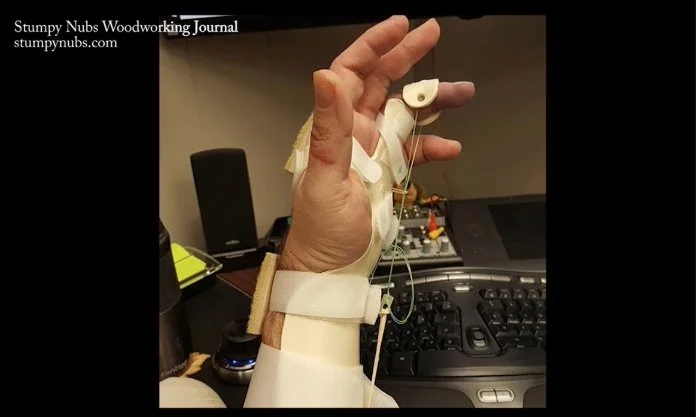
This injury happened in 2019 and I still feel some pain and can’t fully bend my finger.
Pain Isn’t the Only Cost
Some of you probably think I’m exaggerating or that I’m a wimp.
I’m not.
I once shoved a narrow chisel through my hand, pulled it out, went inside, grabbed a sewing kit, soaked the thread and wound in alcohol, and stitched it up myself. Try pushing a sewing needle through flesh — it’s not sharp and comfortable like a suture needle.
So no, I’m not afraid of pain.
But before this injury, I had no idea that it’s not the power tool that hurts — it’s everything that comes after.
And not all pain is physical.
I had decent medical insurance that already cost me hundreds of dollars a month, and this injury still ended up costing about as much as a nice car. The treatments aren’t a one-time thing. They stretched across two calendar years, so I paid my full deductible twice.
Maybe you live somewhere with fully subsidized health care. Good for you.
Can you afford to be off work for two weeks? A month? Remember — this happened in your home shop. No workers’ comp.
What if you can’t do your job one-handed while relearning finger movement at night for three to six months?
Will you lose your job? Your savings? Go into debt? Ruin your credit? Lose your home? Go bankrupt?
This stuff happens to people. That’s what I mean by life-changing injuries.
They can sew fingers back on. They can reattach tendons. But the consequences of unsafe shop practices can follow you for years — or for life.
Your Tools Don’t Care About Your Experience
Some of you are already saying something like, “Only stupid people get hurt,” or the classic, “Respect your tools and they’ll respect you back.”
Your tools have no respect for you.
Even if you respect them, the moment you have a mental lapse, they will make you pay if they can.
Experience and brainpower are irrelevant.
Your brain is not perfect. You forget things. You get distracted. You say, “Oops, that was dumb.” Have you ever run a stop sign by mistake? Drifted lanes? It happens.
Cars can do far more damage than table saws — yet about 50 million people a year are injured or killed in automobile accidents.
How many of those thought they were safe drivers?
I don’t care how long you’ve been woodworking. I don’t care how smart you think you are. You can have a mental lapse at any moment and do something you swore only stupid people do.
In fact, the more experience we gain, the older our brains get — and with age comes more brain farts.
This Isn’t About Fear — It’s About Awareness
Should you be afraid of your tools?
No.
I’m not trying to scare you. I’m trying to stick in your mind.
I don’t want you to stop using power tools. But every time you turn one on, I want you thinking about how one second’s lapse can lead to months, years, or a lifetime of consequences.
I want that knowledge to motivate you to learn how your tools hurt people — and how to avoid becoming one of them.
Think about detached fingers flipping around in sawdust the next time you skip a splitter, riving knife, or push stick. The next time you use a router table without push blocks. An angle grinder without a guard. A jointer with loose sleeves. A nail gun with the safety disabled. A drill with gloves. A chainsaw without leg protection.
Pause.
Think about where your body parts are. Think about what can go wrong. Think about how to protect yourself.
And stop using your past experience as a crutch. Someday, your brain will fart.
Why We’ll Keep Making Safety Videos
We’re still going to make safety videos now and then — because with all the reckless nonsense I see online, I think we need more of them, not less.
Remember: it takes all your fingers to properly enjoy a cold one once the tools are put away.
Because you’ve earned it, my friend.
This post may contain affiliate links. If you make a purchase, we may receive a small commission.
Need some cool tools for your shop? Browse my Amazon Storefront for inspiration.
